

The gap between businesses that lead and those that follow is no longer defined by size, but by intelligence. In an era where data volume doubles every few years, the ability to harness that information instantly is the ultimate competitive advantage.
Digital transformation has evolved from a buzzword into a survival mechanism, requiring tools that are not just powerful but deeply integrated. By 2026, the technology landscape will be dominated by ecosystems that seamlessly blend cloud infrastructure, unified data, and artificial intelligence.
This blog explores how Microsoft's technology stack is reshaping enterprise operations and why a strategic approach to implementation is critical to success.
What Is Microsoft Technology?
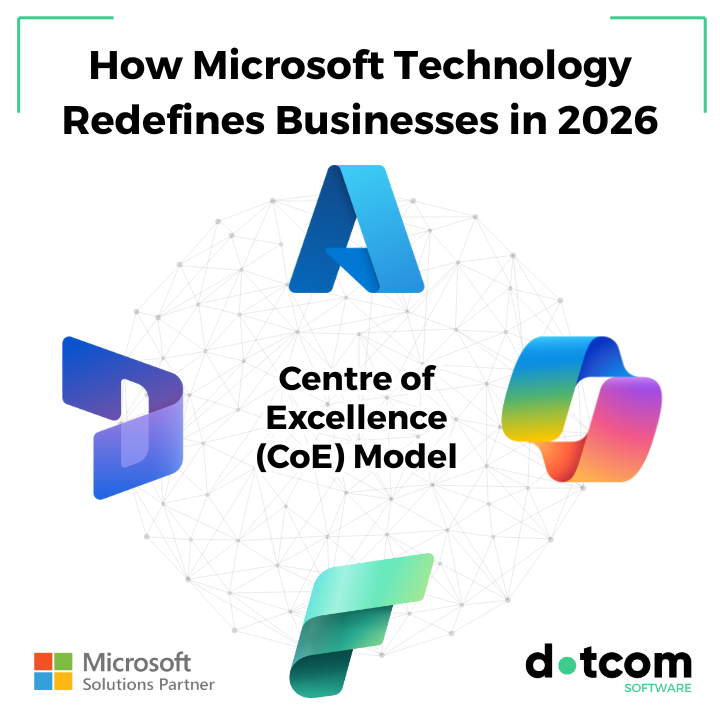
Microsoft Technology is far more than the operating systems and productivity apps of the past. Today, it represents a comprehensive, integrated ecosystem designed to drive enterprise innovation. It encompasses Microsoft Azure (cloud computing), Dynamics 365 (intelligent business applications), Microsoft Fabric (unified data analytics), and Microsoft Copilot (generative AI). Together, these tools form a digital fabric that connects people, data, and processes, enabling organisations to be more agile, secure, and data-driven.
How Is Microsoft Technology Redefining Businesses in 2026?
The convergence of AI and cloud computing is creating new operational models.
Here is how specific Microsoft technologies are enabling this shift.
1. Microsoft Azure: The Intelligent Foundation
Azure serves as the scalable backbone for modern enterprises. By 2026, it will not just be about hosting servers; it will be about accessing advanced AI services securely. With platforms like Azure OpenAI Service, businesses can deploy generative AI models within a secure, compliant environment, which is crucial for regulated industries. Azure also allows organisations to scale computing power instantly to meet demand while protecting sensitive IP with enterprise-grade security.
2. Microsoft Dynamics 365: Connected Operations
Dynamics 365 (D365) breaks down the walls between CRM (Customer Relationship Management) and ERP (Enterprise Resource Planning). In the 2024-2025 release waves, Microsoft heavily integrated Copilot into D365, allowing for proactive insights rather than reactive reporting.
- Customer Service: Agents receive real-time, AI-generated case summaries and response suggestions.
- Supply Chain: Predictive analytics help anticipate stock shortages before they impact the bottom line.
By connecting these functions, D365 ensures that a sales update instantly informs inventory planning, creating a truly synchronised operation.
3. Microsoft Fabric: Unifying Data Silos
Data is often trapped in silos, making it difficult to analyse. Microsoft Fabric resolves this by offering a unified analytics platform.
- OneLake: often described as the "OneDrive for data," OneLake eliminates the need to move or copy data. It keeps data in a single location while making it accessible to various analytics engines.
- Real-Time Intelligence: Fabric empowers businesses to act on data streams instantly, moving from "what happened last month?" to "what is happening right now?"
4. Microsoft Copilot: The AI Productivity Layer
Copilot is not just a chatbot; it is an orchestration engine that works across your data. By integrating with Microsoft 365, D365, and Fabric, Copilot allows employees to use natural language to query complex datasets, draft proposals, or automate mundane tasks. This democratisation of AI means that every employee, technical or not, can leverage the full power of the organisation's data.
Dotcom’s Centre of Excellence (CoE) Model
Implementing these powerful technologies is only half the battle; governing them is the other. This is where Dotcom Software’s Centre of Excellence (CoE) model becomes essential.
A CoE is a strategic framework designed to ensure your technology investments deliver sustained value. Rather than treating software implementation as a one-time project, Dotcom’s approach focuses on continuous improvement and governance.
Key benefits of the CoE model include:
- Standardisation: Establishing best practices across the organisation to prevent "shadow IT" and ensure security compliance.
- Adoption: ensuring teams actually use the new tools effectively through training and change management.
- Innovation: A dedicated focus on how new features (like the latest Fabric or Copilot updates) can be applied to business challenges as they are released.
By partnering with a Gold Microsoft Partner like us at Dotcom Software, businesses gain access to the consulting expertise needed to navigate the complexities of the Microsoft ecosystem, ensuring that technology drives genuine business outcomes.
Ready to Transform Your Operations?
The tools to redefine your business are available today. Whether you need to secure your cloud infrastructure, unify your data, or streamline operations with Dynamics 365, the right strategy is paramount.
Contact Dotcom Software today to discover how our Centre of Excellence can help you build a resilient, data-driven future.